

On Hamnet...
And The Underlying Reasons I suspect It Is Making Whole Cinemas Weep.

For me, the depiction of stories of life and death, and of the human condition as it experiences this, are the distillation of what everything is ultimately about. I still search for, and am gravitated towards, creative pursuits to depict grief as I believe and know it is felt and experienced.
I can tell quite quickly if the creator, writer, director, artist has any capacity in their depiction to justify restraint, and if then, if there is any sanitisation, if there is any even subtle attempt at palletising the experience, its attempt feels defeated—something that could have been depicted so viscerally it could break rock instead runs as simply as water across the page. Because the sanitisation, in any mode, removes the core emotional biology.
Like the billions of other human beings since time began who know grief and loss, I too have experienced the true, bloodied indignity, the complete destruction and recreation of grief, so I experience that attempt—that piece of writing, that scene in the film that might exert restraint—not only by feeling nothing, but a nothing that edges quite quickly into the familiar feeling of atomisation, that familiar invisible glass box lowering around you even momentarily; that disappointment at the missed opportunity to do something that could matter to so many… but also the feeling of being in a world where you and your experience are maybe not somehow truly known, even by those who, with best intentions, are attempting to do it justice.
The particular type of grief being depicted in Hamnet is, I believe, the ultimate task of human survival—that of living through, beyond, and with the loss of a child. When I was watching it at the weekend, there is a moment in one scene, the one that to some extent all other scenes are a preparation for, where the extraordinary Jessie Buckley releases a primal scream from a place inside her, a place inside us, that I believe connects us to every living thing. It is the sound of the place that I felt birth as it happened, and it is the sound of the place that I felt the death of my mother in the precise moments after it happened.
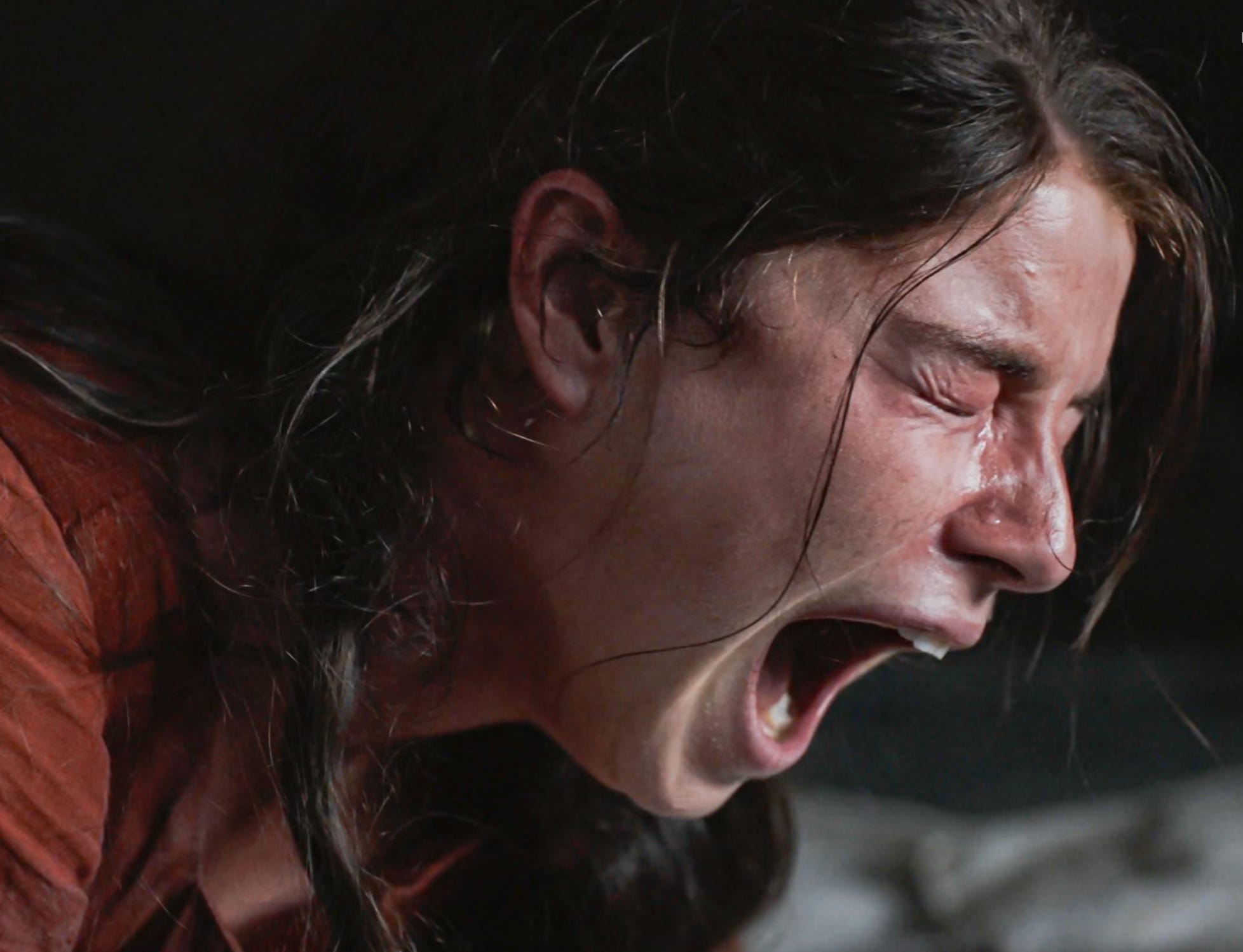
This tearing down of all emotional limitations in the ambition for the film from Chloé Zhao—and similarly in this depiction from Jessie—meant that, as I was watching this particular scene, I had the most extraordinary experience, interestingly one that I haven’t had since I was giving birth. It is an experience I have since learned that other women have experienced in birth too. I had been in labour for 52 hours. I was completely exhausted, and terrified because the midwife hadn’t made it to us in time for delivery, so my husband and I were alone. Just at the point when I felt that the birth of my first daughter was going to devour me whole, when I couldn’t see or feel how I was going to push beyond it, something mysterious, vivid, and visual happened. I can only describe it as a brief and fleeting visitation. I could suddenly feel and see that I was being held in line, connected by hands, each one reaching to the next, with every single woman who had ever given birth and every woman who was going to follow me… I suddenly felt part of something as deep and as enduring as time, where I felt both infinitely small, but also infinitely fortified and strengthened by the knowledge of every woman who were evidence it was possible to bear what, in that moment, felt unbearable—as if the combined strength and courage of every one of them momentarily channelled through me, and quite literally enabled me to render the psychological and physical strength to push my daughter beyond my body.
Watching Hamnet at the moment of the primal scream by Jessie that I have just described, I sat in the dark with many other people I don’t know who, like me, had their faces streaming with tears and snot. The reaction I had wasn’t just about the gut-wrenching performance; it was because I unexpectedly felt flutters of the same thing, but this time a profound feeling of connectivity about our collective and shared emotional biology of grief. It was out of a beautiful sense of relief of seeing that very particular experience of the moment we are forced to bear the unbearable eternal separation from someone we are connected to at a core of our ‘self’ ,being so clearly known, treated with such integrity, care, and courage. It is such a rare thing to find. I suspect that’s why so many other people were weeping around me too.
Not since All of Us Strangers—which I personally think is a masterpiece, which documents a very different mode of grief and loneliness, of how trauma and yearning interplay with memory, of that chasm of temporary madness that grief and loss can take us deep, deep inside—have I seen a rendering of grief by a director, writer, and actor that is so clearly, uncompromisingly attuned to the purpose of emotional truth, and with the skill and ability to depict it in all its mysterious, obliterative, complex, and exquisite agony.
Then I saw Chloé Zhao in a beautiful and emotionally potent interview with Edith Bowman, and Chloé said something which, for me, is the distillation of the purpose of the film, and quite possibly one of the core tasks of being alive. She said: “Until we solve immortality, the void is coming for us all. How can you sit in the tension of impermanence and keep your heart open?”
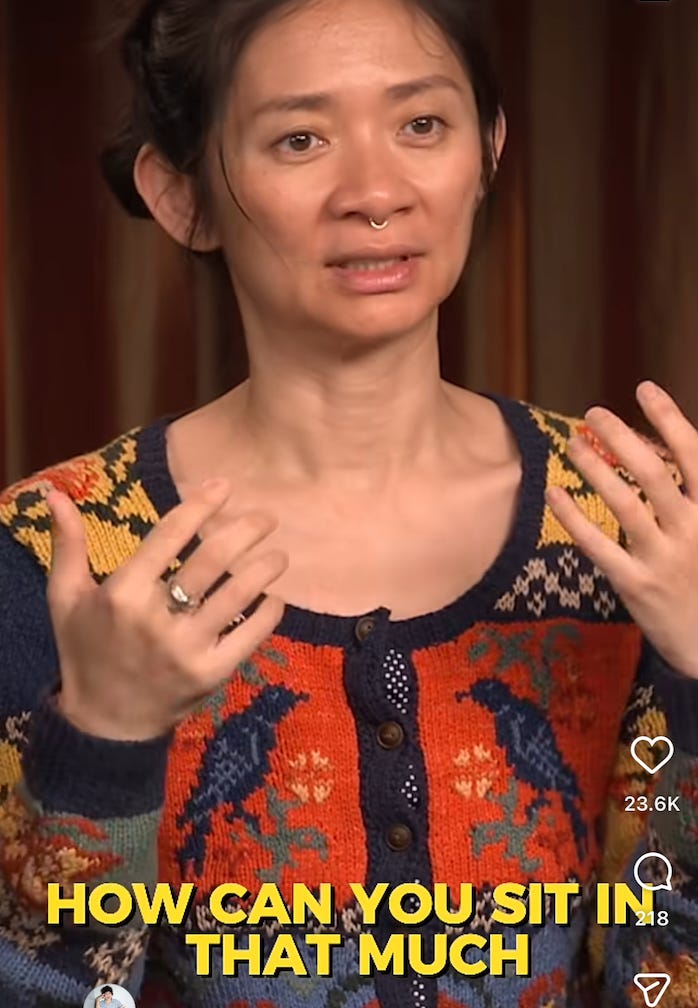
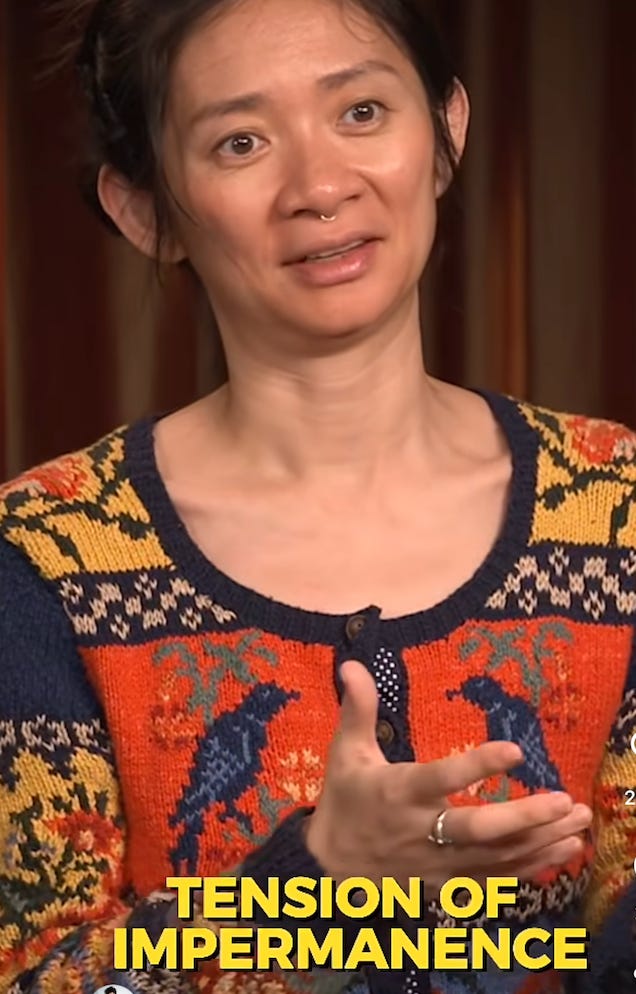
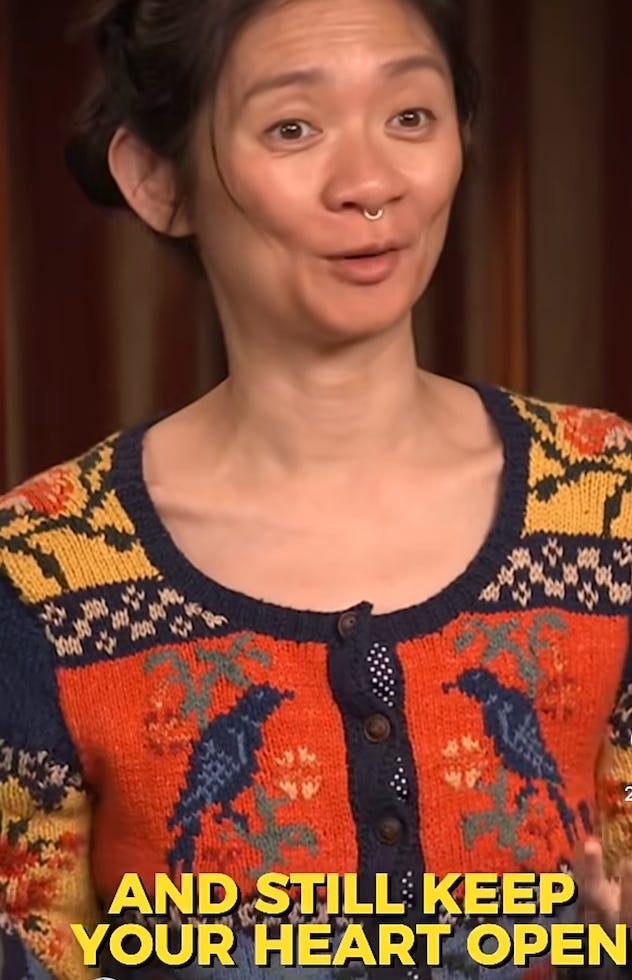
It is absolutely terrifying to love, to live, knowing what death can take. But yet we must, and somehow we do. I think it is one of the ultimate challenges of living.
If you too have been through an existential loss and have seen the film, I would really love to hear your reflections too… and if you haven’t seen it then take yourself, and a big box of tissues. xx
I loved this film so much. I can’t remember the last time I wept through a film like that. I wasn’t prepared for the accuracy of grief depicted. Her scream pierced through my heart and took me back to my best friends funeral. His mother made that same sound when they took his body away. And Agnes’ immediate confusion after that moment, where her eyes are searching and nothing is making sense, that is what it felt like when my husband died. And those moments are truly so visceral I can’t wrap my head around how anyone could act them with that kind of truth. Even having lived through grief so deeply, I don’t think I could translate it on screen like that. And little Hamnet?! How is he so good?! It’s still blowing my mind.
Thanks for sharing this piece. None of my friends are into this but this film has been clanging around my brain since I saw it.
Wow the silence the pain I felt everyone’s grief in that cinema tonight I cannot describe how I’m feeling right now I’m stunned moved and totally exhausted that scene with Hamnet , I’ve never seen that in a film before Jessie Buckley is incredible as are all the cast . My best friend lots both her parents last year I was close to them I grieved for them and her tonight and my father who died 20yrs ago suddenly. Wills mother ‘s monologue about her loss and how grief doesn’t fade . Less words and more facial expressions ensured this experience will stay with me forever